Concealed Carry Hints
[
Why carry? |
Who? |
What? |
Hints on Carry |
Links
]
WHY would anyone WANT to carry a gun?! That is a question
you will doubtless hear quite often from those that lean liberal and
some of the time from others that tend to be more conservative. It is
a question that YOU will need to answer for yourself, and it is best
that you answer that FIRST.
The purpose of this document is to provide a free source for
the information you may find handy if you decide to carry a concealed
weapon. Please use the navigation at the top bar to skip to the
segment you like, or read it top to bottom as you prefer.
Why a permit?
The subject of why you should need a permit has been cussed and
discussed for more than a handful of decades. Many argue that the
2nd Amendment of our Constitution is their permit. From a purely legal
standpoint, it is hard to argue against their opinion. That is unless
you consider the number of people prohibited from carrying, in fact
prohibited from even owning a gun. The permit provides law enforcement
a quick and accurate indication of the individual's legal history, as
related to gun ownership. Why do we even care? Simply because there
are so many within our society that feel THEY have the right to go
without being offended by anyone else in our society. Those are the
very same people that feel THEY are the sole arbiter of what is
offensive and find that everyone else IS offensive if they carry a gun.
Thus they will call for law enforcement if they even catch a glimpse of
a gun, be it real or imagined. A permit can save you time and money
because you do not have to defend yourself in court if you are carrying
legally.
Training
Unlike what those on a testosterone high think, there has yet to be
a person born with knowledge and skills to properly and safely handle
a gun. What does than imply/mean? Simply that YOU will need proper
training in the safety and mechanics of gun use. Once you can handle
the gun safely, you will need training on tactics to not only safeguard
yourself, but others. Let me repeat, NO ONE HAS EVER BEEN BORN
KNOWING HOW TO SAFELY USE A GUN! Training is covered in other web
pages on my site and on many other web sites.
The somewhat thread-bare but none the less valid reasons for
carrying include, but are not limited to:
- Insurance
- Why do you carry insurance on your house? Do you think it is about
to burn down?
- Why do you carry insurance on your car? Do you think it is about
to be stolen?
A Concealed Weapon is a form of insurance, one that - must - be taken
seriously, because the mis-use of that tool can be catastrophic.
- Protect my family
- The police will protect me! - - Sure, if you can wait ten to
thirty minutes while they arrive.
- It is called LAW ENFORCEMENT for a reason. The PD/SO can NOT take
action until someone has broken the law, or shows beyond reasonable
doubt that they are about to break the law.
Many believe they have an obligation to protect not only
themselves but their family from harm.
I believe that is true, do
you?
Why Concealed Carry?
Why some people HATE guns
Sheeple?
The CC Permit Holder
provides quite a few thoughts on what we are and are not. The first
item that each of us MUST decide before you carry concealed is
are you ready to kill someone, if it is necessary, to protect
yourself or another from serious harm? If you can not say
with total honesty that you are, then DO NOT CARRY! The very
worst thing you could do is to go through the vetting process, get
your permit, begin to carry and then hesitate after you have drawn
your weapon to defend yourself or others. You MUST make that mental
commitment to take any necessary action, or you should NOT carry.
Attitudes for CC See if you can get along
with the attitudes necessary for CC with minimal/no problems with LEOs.
If you firmly believe that your "rights" supersede anyone else's, you
may want to seriously think about NOT getting your permit. The officer
has ALL of the rights you have, but has a job that puts them in daily
contact with individuals of minimal intelligence. DO NOT look like
one of those people to the LEO.
The following items are sequenced by importance to you. There can
be slight adjustments, but ALL are important.
- The first item you must do is to read and understand the laws in
your state concerning concealed carry! Read AND UNDERSTAND!
Handgun Law is a web site that
has state by state summaries of the laws pertaining to concealed
carry. That is an excellent starting point, but you also need to
refer to the specific laws/statutes in your area. Department of
redundancy department, UNDERSTAND THEM - before - you carry.
- Get some training! There are many that will whine/cry that
it is their "Constitutional Right" to carry concealed, therefore they
do not need training. WRONG! Two hundred years ago it
was "common knowledge" that guns were part of our society. The vast
majority of households had guns and almost everyone had what training
there was available. That is no longer the situation. While many houses
DO have guns, and many within those houses do receive training, that
training is not adequate for concealed carry (reference number 1
above).
In addition, those with an excess of testosterone tend
to believe THEY are uniquely able to handle their weapons safely,
just because they own one (reference number 3). Concealed carry
requires a unique skill set to be able to handle yourself and
anticipate situations that can easily occur. The more knowledge you
have about concealed carry, the more likely you are to NOT have
an unfortunate situation happen.
A few thoughts on training include:
Defensive Shooting and
Live Fire Exercises
Is it LEGAL?
- Safety!
Gun Safety
is an essential item for anyone that handles, much less carries a gun.
You will often hear a gross oversimplification of gun safety rules when
someone says "Treat every gun as if it were loaded!" HOW DO YOU DO
THAT?! By following the FOUR rules presented in the linked page.
- A major item to think about:
Once you have your permit/license and you are carrying, BE SURE
you keep one fact in mind. If you are unfortunate enough to be present
during a robbery, OVER 60% of the people doing an
armed robbery, HAVE AN ARMED ACCOMPLICE! In other words,
the robber is SELDOM alone. Do you want to get shot in the back as you
try to stop the robbery? NOT ME!
The following are hints from several people on Ruger Forums
- From allabtslfdef:
Concealed means concealed. If you keep that in mind you will be good to
go. I saw a signature one time that said always carry, never tell.
Those are good words to live by.
- From slinger56:
PRACTICE,and when you are tired of that, take a rest and then practice
some more. Next week,,,,,,,practice again. Practice with the gun,
holster, and concealed method(s) you plan on using. Practice on
realistic targets at realistic distances. If you need to, seek out
experienced folks who may train you or share tips on just HOW to get
that gun out of the holster without shooting your foot off, or without
muzzle sweeping half of your state in the process. Then, PRACTICE!
Don't worry about speed, focus on accuracy. Did I mention PRACTICE ??
- From Pat-inCO:
** One statement from a national shooting champion is worth mentioning
"You can not miss fast enough to win."
** Now a few things to think about (how do YOU want to handle these
situations):
~ Use of indoor facilities:
~~~ Urinal - Can you use the receptacle and have your carry piece
protected? In some places there is a long line of receptacles. Is there
one available that will put your carry rig against a blank wall?
~~~ Sit-down receptacle - Where will you place your gun while you are
"busy doing paperwork"? Is there one with a blank wall on the side
where your gun is?
~ Winter:
~~~ When you take off your coat, will your gun become uncovered? It
gets really hot with a heavy coat on, indoors. You also draw attention
to yourself if you are wearing a heavy coat indoors and sweating.
~ Summer:
~~~ Hot days often require different carry rigs. Investigate the
possibilities - before - you need them.
~~~ Think about techniques that allow you to have your gun "hidden in
plain sight". Some carry rigs (fanny pack, SafePacker) allow you to
have team logos sewn on. That will reduce the "gun" image.
~~~ Will your carry rig allow you to protect the gun from sweat?
Saves cleaning the gun every time you carry it.
** The last item is, exercise due diligence in your setup, then RELAX.
Just because someone looks at you, it does - not - mean they have made
your rig (If they stare, you may be in trouble ). Allow yourself to
relax while remaining aware.
- From JustPlainDirt:
First practice safe gun!
**Read "In the Gravest Extreme" before you strap on anything. If you
can't wait to get the book then at least, read every on-line article
and video you can about, for, from or with, Massad Ayoob. (don't do
like I did initially and discount this guy because his name sounded
like maybe a foreigner's.). Critique every single gun related crime
you can; as if you were an armed bystander. What would you do? How
would you do it? Put your mind in the shoes of victim(s). Create any
imaginary scenario you can think of with yourself, your family,
co-worker, friends, neighbor and include coming to the aid of a police
officer. Prepare yourself. If you can imagine it, it can happen! The
unimaginable happens all the time. If you have to shoot a home invader
at night, which direction is it safe for you to shoot from where you
stand? Do the same exercise for daytime hours. It seems ludicrous to
think about safety when you have to shoot somebody and, if you do, it
may get you killed. Know in advance!
** Learn who Jeff Cooper is and why you care. Research "The Lakewood Four"
(Nov 29, 2009), what if you had just stopped in for a latte? (There are
hundreds of these types of incidents that have gone down over the
years.) Know the laws of your state, understand 'felony force' and how
it applies to your incident. Practice close quarters shooting. A
bullseye at 15 yards is nothing like a tweaker* at two feet.
** And, certainly not the final word on the subject, but, it might behoove
you to know about, "The Armed Citizens Legal Defense Network"
** It is important to know how to shoot, it's imperative to know
when.
- From CARSINC:
Learn what to do and say if
you draw your weapon and don't fire. Learn what to do and say if you do
draw your weapon and fire. Retain a lawyer who knows concealed carry
and has a record of defending CCW cases. Carry his/her card in your
wallet and have the number in your cell phone. Never stop practicing
and training - you want muscle memory, not just the ability to draw,
point and shoot. Spend some time with someone experienced in CCW. Learn
situational awareness, who is around you, what are they doing. Avoid
situations where you have a high probability of needing a weapon.
- From BearTaylor:
** Avoid a gunfight if possible.
** Don't shoot anybody that doesn't deserve it.
** Never let a bad guy get control your weapon. If you do you're dead.
** Don't draw a gun unless you know you can pull trigger if you have to.
** Keep in mind that your bullet may continue on after passing through
your target.
** Get to know a good lawyer and don't say anything you'll live to regret
after an incident.
- From BuckeyeBlast
Train. Don't just go to the range and shoot paper while standing still.
Marksmanship does not equate to handgun fighting skills when you're
under stress. Join a range that has IDPA shoots. Don't be intimidated,
some of the guys are amazing, ask for instruction and then start
competing. You're shooting while moving at multiple targets, with some
form of stress, and you're starting off with drawing from concealment.
All things that could save your life.
** Don't cheap out on a holster. The last thing you want is something that
pulls heavy on your belt, doesn't conceal well, and could lead to
dangerous retention problems.
**Be smart, be mature. You'll find you're more calm when CCW'ing. It's
not just a right, it's now a responsibility. You represent all of us
when you carry. KNOW your laws, think about scenarios, ask questions of
others and yourself. If you do something wrong, it's likely to punish
all of us. Again, it's not just a right, it's a responsibility.
Remember that if nothing else.
- From martinj001
I did see mention of not cheaping out on the holsters, but you might
want to add not cheaping out on a belt too. If a person spends big
money on a holster and cheaps out on the belt to carry it on, it ain't
worth much. A good belt and a good holster are just as important as
the weapon that goes in them.
- From Tracer
You should choose a brand of pistol and type of caliber that number
one, fits your hand and feels good, second choose a caliber that you
can handle and shoot well from the get go.
- From Stirfry
1. don't just assume an IWB holster is the best way to conceal a gun.
2. "this gun/holster is so ______, I almost forgot I was carrying it"
... it not always a good thing.
3. if you carry a small or light gun, a "good gun belt" adds more bulk and stiffness than is needed.
4. a good holster, on the other hand, is mandatory.
5... sure, "hiding" the gun is important... but don't let that override
the need to access it when needed. (I pocket carry at times, but seated
in a car you will never be able to access it. plan/think ahead)
6. smaller is not always better (doesn't matter how easy it is to hide,
if you can't shoot it well)
7. laws, laws, laws!
- From ncspeedsix
Ask your local LEOs what type of ammo they use and consider using the
same in your gun. That way, if you are ever asked on the stand why you
chose to use a particular type hollow point in your gun, you can
respond that you were using the same round that the local police force
uses. This may seem trivial, but prosecutors may attempt to make the
defendant out to be overly aggressive in his selection of ammunition
for his firearm, and this will keep you covered.
Along those lines, consider using a firearm for defense that has not
modified in any way since you acquired it NIB. Ie, right out of the box
with the factory trigger etc. If your weapon is involved in a shooting,
you can be sure that ballistics experts will be examining it. If your
gun has a modified trigger, the prosecutor can use that against you by
arguing that you put a lighter trigger on your weapon so that you could
pump more rounds into your target at a faster pace, and therefore may
have used excessive force in stopping your threat. These may seem like
trivial details, but any advantage that the prosecutor has to stir up
the jury, you can be sure they will try to use to their advantage.
- From hariph creek
Once you've figured out your CC rig, wear it around the house until it
doesn't feel like a foreign object anymore. That way you will feel and
look natural in public. Thus avoiding constant adjustments, checks and
having shifty or guilty looking eyes when you look people in the face.
Some final Thoughts
- The BEST gunfight, is the one you were not even near.
Many seem to be looking for trouble and if you do, you could easily
find far more than you anticipated. There are significant legal
repercussions in the use of a firearm for anything but personal
protection (obviously not talking about target practice or hunting).
- Bullet Set-back: One thing that many have not heard about,
but is non the less VERY important is bullet set-back. This occurs
in EVERY manufacturers ammunition, to some degree or the other. It
happens when the slide picks up a fresh round from the magazine and
pushes it into the chamber. The bullet is forced back into the case
by anything from one or two thousandths of an inch to FAR more than
that. The cheaper the ammunition the more likely it is to have the
set-back be larger, and even the best ammunition experiences it
after multiple chamberings.
The problem comes when the set-back becomes large enough that the
cartridge will no longer chamber correctly. If you can finally get a
cartridge chamber that has significant set-back, it WILL experience
over pressure and function improperly.
How can you avoid set-back? Simple, once a round is chambered,
either shoot it, or use it for practice ammunition. IN NO CASE,
should you be chambering a round more than twice! There are many
people that unload their pistol each night and reload it in the
morning. If you have a VERY specific reason for doing that, make
sure that you put the previously chambered ammunition in a box
that is just for range practice! Failure to do that can easily
cause significant problems.
(obviously not an issue in revolvers)
- The following is a summary of five year's articles published by
the NRA in the "Armed Citizen" segment of its publications. There are
482 incidents reported but many do not include shooting (hint, hint).
It addresses many of the over-reaction comments we frequently see in
Internet opinions on gun forums. Read it and decide for yourself.
- Shots were fired by the defender in 72% of the 482 incidents.
- If the defender fires any shots, it will most likely be 2 rounds.
This does NOT imply a 2 shot derringer is "good enough".
If more than 2 shots were fired, it generally appeared that the defender's
initial response was to fire until empty, or that the caliber was
inadequate for the need.
- Private citizens needed to reload in 3 of the 482 incidents.
That is one half of one percent of the shootings.
- In the vast majority of shootings, the distance was slightly
in excess of arm's length. This strongly implies that extensive
practice at 25 yards is not necessary for self defense. In my opinion,
15 or so FEET is far better.
The perceived need for massive quantities
of ammo, reloading, and precision shooting at distance is largely a
figure of people's imaginations. There is simply no evidence to support
the contention that any of those conditions occur during most armed
confrontations involving the private citizen.
- 52% of incidents took place in the home, with 32% being in a
business. Incidents in public places were 9% and 7% occurred in or
around vehicles.
- The most common source crimes were: 1)armed robbery - 32%, 2)home
invasion - 30%, 3)burglary - 18%.
- Most commonly, criminals acted in a shark-like fashion, slowly
circling and alerting their intended victims. Anyone heard of
situational awareness?
- Handguns were used in 78% of incidents while long guns were used
in 13% and the remainder were not reported.
- The most common size of handgun was the .35 caliber family (.38,
.357, 9mm) at 61%. 380s and below were at 23%, and those starting with
a .4 or larger were 15%. Proof that having a gun available is more
important than its caliber, but I still think something starting with a
point four is an advantage.
- The firearm was carried on the person of the defender in only 20%
of incidents. In the remainder, the firearm was obtained from a place
of storage, frequently in another room. When you remember that over half
of the incidents were in the home, this is easier to understand.
- Multiple conspirators were involved in 36% of the incidents.
However, there are no apparent cases of drivers or lookouts acting as
reinforcements for the criminal actor(s) once shooting starts. Please note,
this statistic is for all encounters documented in the NRA publication
and not just for the armed robberies noted above.
- Many people seem to live in fear of over-penetration. That is
where a shot will pass through a BG and strike an innocent person
behind him. The FBI did a major analysis of penetration as part of
their effort to find the "optimal" round for their agents to cary.
Their results do not
agree with the worry.
- If you are involved in a shooting and the Bad Guy (BG) turns to
leave, let him leave! There are many well documented cases where
the GG was totally in the right, until he took just one more shot than
was necessary to stop the incident, and ended up in SERIOUS trouble.
There was one where a doctor had
someone come onto his property and break in to his house. The good
doctor used a .22lr revolver to convince the BG of the error in his
ways. Once the BG turned to leave the doctor took one more shot (that
he swears was into the ground) as an additional warning to the BG that
he was being watched. That shot hit the BG in the butt. End result, the
doctor lost his farm, all of his guns, did jail time, and can NEVER
own a gun again. All, just for a "warning" shot. - - If the BG
turns to leave, LET HIM GO!
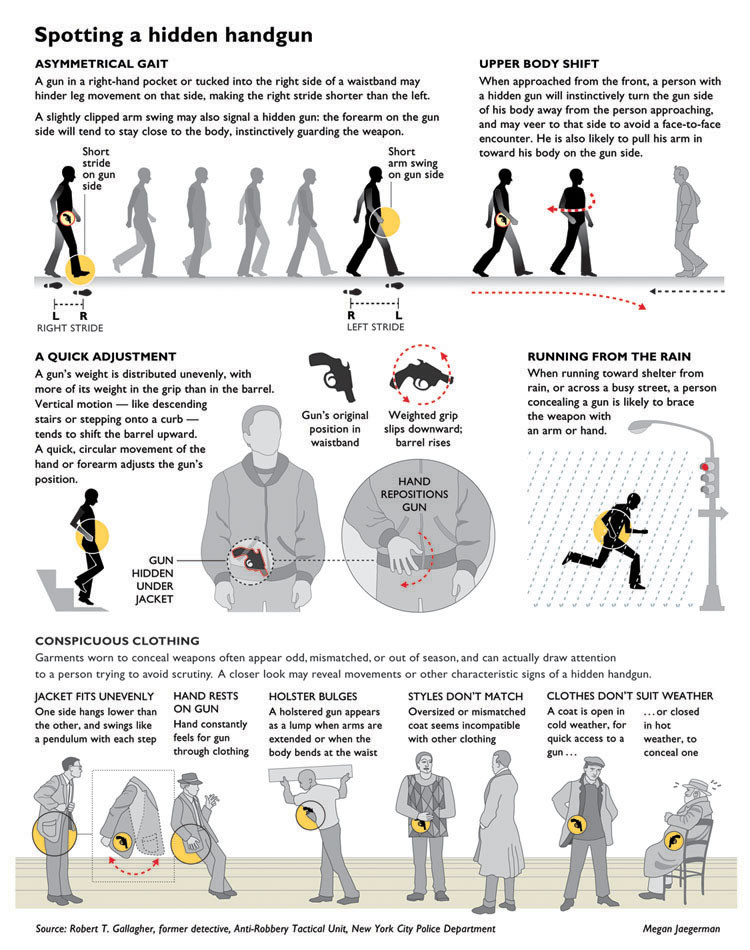
- Here is a diagram that I found in no less than twenty web sites
so I will rely on the source's name included in the diagram for
credit. It details some of the more prevalent errors people will make
when carrying concealed. Do your best to avoid them!
The following are links to information that seems very useful.
E-mail at:
w0ipl@arrl.net